
Clinical assessment
Tripod sign: what a positive really meanshow to perform, interpret and confirm the seated hamstring length test
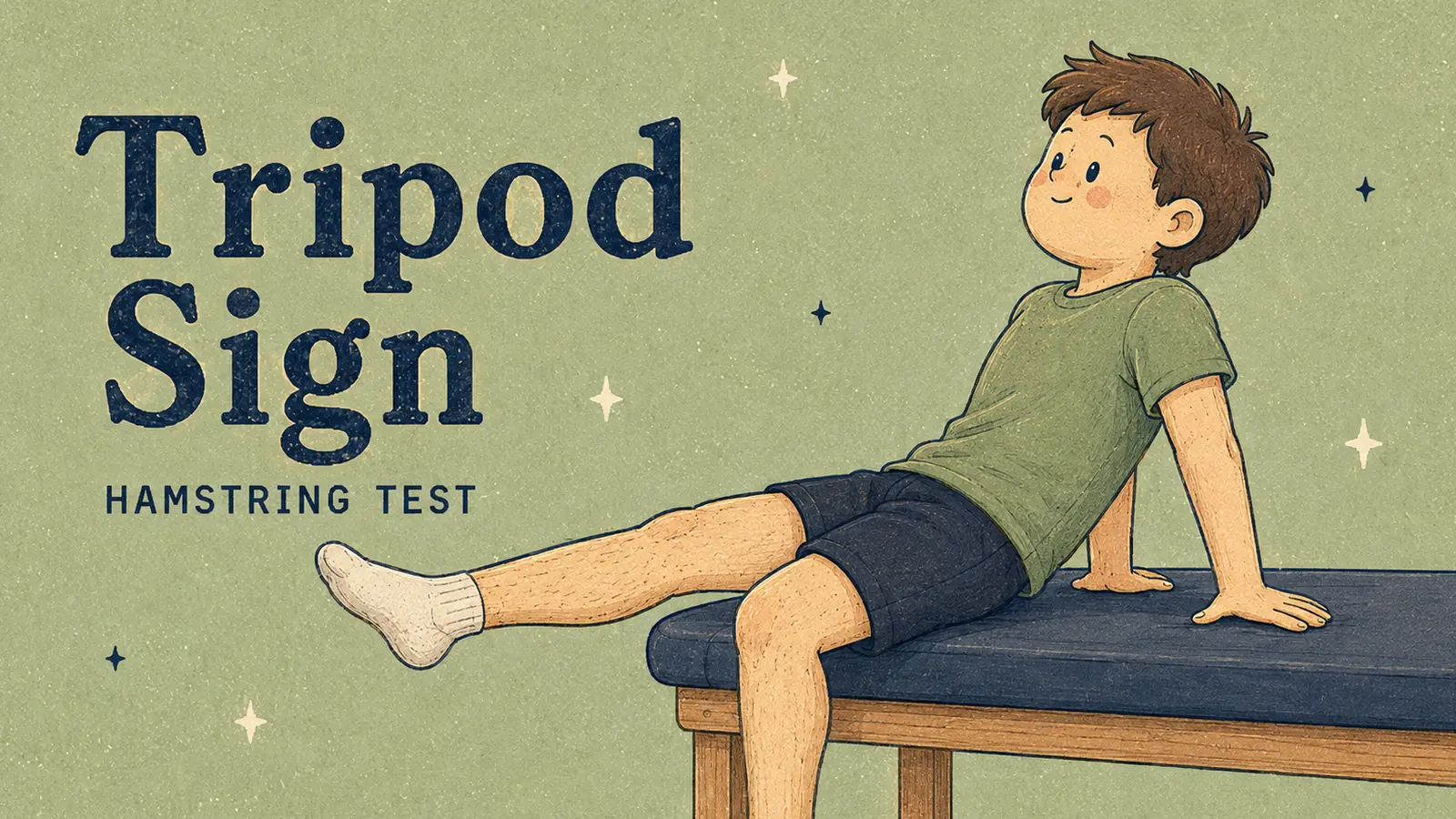
The tripod sign is a seated test of hamstring length. The examiner straightens one knee while the patient sits on the edge of a plinth and watches whether the trunk leans back to make room. It takes less than a minute and needs no equipment, which is why it appears in most orthopaedic assessment curricula. It is also frequently misread, because the same movement that lengthens the hamstrings also loads the sciatic nerve, and a lean back can come from either.
This article covers what the test is, how to perform it consistently, what the three possible findings mean, what the evidence does and does not support, and how to confirm a positive with a measured test. The short version: a positive tripod sign tells you that knee extension in sitting is limited by tension in the back of the thigh. Whether that tension is muscular or neural is a separate question, and answering it is the clinically useful part.
Key points
- What it assesses: hamstring muscle length. Magee describes it as a seated hamstring contracture test.
- Positive finding: the trunk extends or leans back as the knee is passively straightened.
- Accuracy: no sensitivity, specificity or reliability data have been published for the test itself.
- Confirm with: the active knee extension test, measured with a goniometer.
- Escalate when: the patient reports pain, tingling or numbness travelling down the leg rather than a pull in the thigh.
1. What the tripod sign is
The hamstrings are a group of three muscles on the back of the thigh that cross two joints: they originate at the sitting bone (ischial tuberosity) and attach below the knee. Flexing the hip lengthens them at one end; straightening the knee lengthens them at the other. Sitting upright already holds the hip at roughly 90 degrees of flexion, so extending the knee in this position asks the muscle group for close to its full length.
Magee, in Orthopedic Physical Assessment, describes the tripod sign as a seated hamstring contracture test. If the hamstrings reach the end of their available length before the knee is straight, the patient extends the trunk, which tilts the pelvis backward and reduces hip flexion. That is the positive sign. The name comes from the posture a strong positive produces: the patient leans back and props onto both hands, so the two arms and the pelvis form a three-point base.
Magee also notes, in the same description, that nerve root irritation can produce the same trunk response. This caveat is often dropped when the test is taught, and it is the main reason the tripod sign is misinterpreted. Section 3 covers how to tell the two apart.
2. How to perform the test
- Position the patient. Seat them upright on the edge of the plinth with hips and knees at about 90 degrees, feet unsupported and hands resting on the thighs. Ask them to sit tall. The sign depends on a change from a neutral start, so a slouched starting posture will mask it.
- Passively extend one knee. Support under the ankle and straighten the knee slowly, keeping the thigh in contact with the plinth so the hip stays near 90 degrees. Stop at full extension or at the first clear sign of compensation.
- Observe the trunk and pelvis. Watch for trunk extension, a lean back onto the hands, lumbar slouching or posterior pelvic tilt. Also note whether the opposite thigh lifts or the patient slides forward on the plinth; these are compensations too.
- Ask what the patient feels and where. Use an open question. A pull or tightness that stays in the back of the thigh is the expected sensation for muscle. Pain, tingling or numbness, particularly below the knee, is not.
- Repeat on the other side and compare. Record the approximate knee angle at which compensation began, the patient's description of the sensation, and any asymmetry.
Three technique errors account for most inconsistent results. Extending the knee quickly provokes a protective muscle response and makes the test look more positive than it is. Letting the thigh lift off the plinth reduces hip flexion and makes the test look more negative. And priming the patient with a phrase such as "tell me when it hurts" shapes the report you are trying to gather; ask what they notice instead.
3. Interpreting the finding
Most descriptions stop at "positive means tight hamstrings". In practice there are three readings, and the distinction between the first two changes the management plan.
Select a finding to see how it is interpreted.
The overlap exists because the tissues run together. Knee extension with the hip flexed lengthens the hamstrings and, at the same time, tensions the sciatic nerve and the lumbosacral nerve roots it comes from. A systematic review by Scaia, Baxter and Cook (2012) made the same point about the straight leg raise: pain from sources that are not radicular, including hamstring tightness, can produce false positives. A positive tripod sign tells you that something in the posterior chain has reached its limit. It does not tell you which tissue.
4. Tripod sign, straight leg raise and slump test compared
These three tests load overlapping structures, which is why they are often confused. They answer different questions and carry very different amounts of evidence.
| Tripod sign | Straight leg raise | Slump test | |
|---|---|---|---|
| Position | Sitting, knee passively extended | Supine, straight leg passively raised | Sitting, spinal and neck flexion, then knee extension and ankle dorsiflexion |
| Primary question | Is hamstring length reduced? | Is a lumbar nerve root involved? | Is neural tissue mechanosensitive? |
| Positive finding | Trunk extension or lean back | Reproduction of radiating leg pain | Reproduction of symptoms, eased by neck extension |
| Published accuracy | None | Pooled sensitivity 0.92, specificity 0.28 for disc herniation (van der Windt 2010) | Sensitivity 0.84, specificity 0.83 against MRI (Majlesi 2008) |
For readers new to these terms: sensitivity is the proportion of people with the condition who test positive, and specificity is the proportion without the condition who test negative. The straight leg raise is highly sensitive for lumbar disc herniation but poorly specific. Devillé and colleagues pooled sensitivity at 0.91 and specificity at 0.26 in 2000, and the later Cochrane review by van der Windt and colleagues reached similar figures in surgical populations, at 0.92 and 0.28. In plain terms, a negative straight leg raise makes a disc herniation less likely, but a positive one is common in people who do not have one, and tight hamstrings are one reason why. The crossed straight leg raise, where raising the unaffected leg reproduces pain on the affected side, behaves the opposite way, with pooled specificity of 0.90 and sensitivity of 0.28.
One detail matters specifically for the tripod sign. Its mechanics are those of a seated straight leg raise without any added neural loading. Rabin and colleagues (2007) found that the seated straight leg raise was considerably less sensitive than the supine version in patients with MRI-confirmed nerve root compression, at 0.41 versus 0.67. The slump test is more sensitive because it adds spinal flexion, neck flexion and ankle dorsiflexion to the same knee extension. In Majlesi's study it detected 84 percent of imaging-confirmed disc herniations compared with 52 percent for the straight leg raise, although the straight leg raise was slightly more specific at 0.89 versus 0.83. The practical consequence: a tripod sign that is negative for leg symptoms does not exclude a nerve root problem. If the history suggests one, test for it directly. Our reference entries for the straight leg raise and the slump test carry the full technique and accuracy data.
5. What the evidence says about the tripod sign itself
There is no published diagnostic accuracy or reliability study of the tripod sign. Magee describes the test without accuracy figures, and we could not find a study measuring how consistently two examiners agree on the sign, or how often it is positive in people with and without short hamstrings. Sensitivity, specificity and likelihood ratios are simply not available for it.
This does not make the test worthless. It makes it a screening observation rather than a documented finding. It is quick, it directs your attention, and it tells you which measured test to do next. It is not sufficient on its own to record a diagnosis of hamstring shortening, and it should not be quoted with accuracy figures it does not have.
The confirmatory test: active knee extension
The active knee extension (AKE) test, sometimes called the 90/90 test, has the evidence the tripod sign lacks. The patient lies supine with the test hip held at 90 degrees of flexion, actively straightens the knee as far as possible, and the examiner measures the remaining knee flexion angle with a goniometer. Because the hip is fixed and the measurement is numeric, the result can be compared across sessions and between examiners.
- Gajdosik and Lusin (1983) reported test-retest reliability of 0.99 for both limbs in 15 men using a pendulum goniometer with the hip stabilised at 90 degrees.
- Hamid and colleagues (2013) found inter-examiner agreement (ICC) of 0.87 for the dominant knee and 0.81 for the non-dominant knee in 14 healthy adults, with 93 percent of dominant-knee measurements agreeing within 10 degrees.
- Olivencia and colleagues (2020) reported inter-examiner ICC of 0.886 and intra-examiner ICC of 0.882 in 71 asymptomatic adults, with a standard error of measurement of 4 degrees and a minimal detectable change of 12 degrees.
An ICC close to 1 means two measurements of the same person agree closely. The minimal detectable change is the more useful number day to day: a change smaller than about 12 degrees between sessions may be measurement error rather than a real change in muscle length. Keep this in mind before attributing a 5-degree improvement to a stretching programme.
On thresholds, the conventional cut-off for short hamstrings is a knee extension deficit greater than 20 degrees with the hip at 90 degrees, which is the inclusion criterion Davis and colleagues used in their 2005 stretching trial. A 2024 normative study by Lim questioned that single number: in healthy adults the value two standard deviations below the mean was 19.7 degrees in men and 15.7 degrees in women, and people who exercised regularly had more range. Treat 20 degrees as a reasonable convention, not a validated diagnostic line, and weigh it against the other side and the patient's function.
Documenting the finding. "Tripod sign positive on the right" records an observation. "Right AKE 28 degrees from full extension, left 12 degrees; posterior thigh pull only, no distal symptoms; slump test negative" records an assessment that another clinician can act on and re-measure. The second version takes two extra minutes.
6. If reduced hamstring length is confirmed
Reduced hamstring length is common and is not a problem in itself. It becomes relevant when it is linked to symptoms, such as posterior thigh tightness during running, or to a functional limit the patient cares about. When treatment is indicated, the evidence supports two approaches.
Static stretching is the best studied. In the Davis trial, a single 30-second static stretch performed three days a week for four weeks increased hamstring length in young adults with an AKE deficit above 20 degrees, and was the only technique that differed significantly from control at four weeks. The groups were small (four to five participants each), so the comparison between techniques is preliminary, but the direction matches the wider stretching literature.
Neurodynamic sliding is a useful alternative when the stretch sensation is neural rather than muscular. Castellote-Caballero and colleagues (2014) randomised 120 asymptomatic adults with short hamstrings to a sciatic nerve sliding technique, static stretching or a placebo. Immediately after a single session, the sliding group gained more straight leg raise range than the stretching group, which in turn gained more than the control group. The study measured immediate effects only, so it tells you what works in a session, not what persists.
If the tripod sign was positive because of radiating symptoms, hamstring stretching is not the treatment. Complete the neural assessment and manage what it shows.
7. Other tests that share the name
Two other clinical observations are called the tripod sign. They are worth knowing so that a reference to "tripod sign" in a textbook, a paper or a ward round is read in the right context.
- The seated leg-raise observation in back pain. A 2007 clinical pearl published in Clinical Advisor proposed that a patient with genuine nerve root pain, when a seated leg is raised to 45 to 60 degrees, will naturally lean back and brace on both arms, and that a patient who does not may be reporting pain that is not present. This has not been validated and no accuracy data exist. The broader literature on non-organic signs cautions against using any single behavioural observation to infer symptom exaggeration. Treat it as a prompt to look more closely, not as evidence.
- The paediatric and infectious disease sign. In poliomyelitis and other causes of spinal or meningeal irritation, a child who is asked to sit up props on both hands placed behind the trunk, because flexing the spine is painful or the hamstrings are contracted. Nichols described the tripod sign in polio in a 1994 letter in Hospital Practice. The posture looks the same; the setting and the cause are different.
The hamstring length test described in this article is the one meant in musculoskeletal physiotherapy. When a source says "tripod sign", check which one it is describing before quoting it.
Frequently asked questions
What does a positive tripod sign mean?
A positive tripod sign means the patient leans back or extends the trunk when a knee is passively straightened in sitting. The classic interpretation is reduced hamstring length. The same response can occur with nerve root irritation, so the patient should be asked what they feel: a pulling sensation in the back of the thigh is consistent with muscle tension, while pain, tingling or numbness travelling down the leg points to neural tissue and needs further testing.
Is the tripod sign reliable or accurate?
No published study has reported sensitivity, specificity or inter-examiner reliability for the tripod sign. It should be treated as a screening observation rather than a diagnostic test. To document hamstring length, follow a positive finding with the active knee extension test, which has been studied repeatedly and has good to excellent reliability.
How is the tripod sign different from the straight leg raise?
Both movements lengthen the hamstrings and load the sciatic nerve, but they are used for different purposes. The tripod sign is a seated observation of hamstring length. The straight leg raise is a supine test for lumbar nerve root involvement, with high pooled sensitivity (about 0.9) but low specificity (about 0.3), partly because tight hamstrings can produce a false positive. A seated knee extension without added neural loading is a weak test for nerve root problems, so a clear tripod sign does not exclude them.
How do I confirm a positive tripod sign?
Use the active knee extension test. With the patient supine and the hip held at 90 degrees, ask them to straighten the knee actively and measure the remaining knee flexion angle with a goniometer. A deficit above roughly 20 degrees is the conventional threshold for short hamstrings, although cut-offs vary by sex and activity level. Differences smaller than about 12 degrees between sessions fall within measurement error.
I have been told I have a positive tripod sign. Should I be worried?
Usually not. In most people it simply indicates that the hamstrings are on the shorter side, which is common and often has no symptoms. It becomes relevant when it is linked to a problem such as posterior thigh tightness during activity or low back discomfort. If the test produced shooting pain, tingling or numbness down the leg, tell your clinician, because that suggests the nerve rather than the muscle is sensitive and the assessment should go further.
Revise the hip muscle length tests
The tripod sign sits in our hip muscle testing reference alongside the Thomas, Ely, Ober and 90-90 straight leg raise tests, each with performance steps, interpretation and a demonstration video. The flashcard decks schedule the same material for spaced review.
References
- Magee, D. J. (2014). Orthopedic Physical Assessment (6th ed.). Elsevier.
- Gajdosik, R., & Lusin, G. (1983). Hamstring muscle tightness: reliability of an active-knee-extension test. Physical Therapy, 63(7), 1085–1090. PMID 6867117
- Hamid, M. S. A., Mohamed Ali, M. R., & Yusof, A. (2013). Interrater and intrarater reliability of the active knee extension (AKE) test among healthy adults. Journal of Physical Therapy Science, 25(8), 957–961. PMC3820221
- Olivencia, O., Godinez, G. M., Dages, J., Duda, C., Kaplan, K., & Kolber, M. J. (2020). The reliability and minimal detectable change of the Ely and active knee extension tests. International Journal of Sports Physical Therapy, 15(5), 776–784. PMC7575148
- Lim, W. (2024). Optimal cut-off values of the active knee extension test for diagnosing hamstring tightness. Journal of Bodywork and Movement Therapies, 40, 1769–1773. PMID 39593522
- Davis, D. S., Ashby, P. E., McCale, K. L., McQuain, J. A., & Wine, J. M. (2005). The effectiveness of 3 stretching techniques on hamstring flexibility using consistent stretching parameters. Journal of Strength and Conditioning Research, 19(1), 27–32. PMID 15705041
- Castellote-Caballero, Y., Valenza, M. C., Puentedura, E. J., Fernández-de-las-Peñas, C., & Alburquerque-Sendín, F. (2014). Immediate effects of neurodynamic sliding versus muscle stretching on hamstring flexibility in subjects with short hamstring syndrome. Journal of Sports Medicine, 2014. PMC4590905
- Scaia, V., Baxter, D., & Cook, C. (2012). The pain provocation-based straight leg raise test for diagnosis of lumbar disc herniation, lumbar radiculopathy, and/or sciatica: a systematic review of clinical utility. Journal of Back and Musculoskeletal Rehabilitation, 25(4), 215–223. PMID 23220802
- Devillé, W. L., van der Windt, D. A., Dzaferagić, A., Bezemer, P. D., & Bouter, L. M. (2000). The test of Lasègue: systematic review of the accuracy in diagnosing herniated discs. Spine, 25(9), 1140–1147. PMID 10788860
- van der Windt, D. A., Simons, E., Riphagen, I. I., Ammendolia, C., Verhagen, A. P., Laslett, M., Devillé, W., Deyo, R. A., Bouter, L. M., de Vet, H. C., & Aertgeerts, B. (2010). Physical examination for lumbar radiculopathy due to disc herniation in patients with low-back pain. Cochrane Database of Systematic Reviews, (2), CD007431. Cochrane Library
- Majlesi, J., Togay, H., Unalan, H., & Toprak, S. (2008). The sensitivity and specificity of the Slump and the Straight Leg Raising tests in patients with lumbar disc herniation. Journal of Clinical Rheumatology, 14(2), 87–91. PMID 18391677
- Rabin, A., Gerszten, P. C., Karausky, P., Bunker, C. H., Potter, D. M., & Welch, W. C. (2007). The sensitivity of the seated straight-leg raise test compared with the supine straight-leg raise test in patients presenting with magnetic resonance imaging evidence of lumbar nerve root compression. Archives of Physical Medicine and Rehabilitation, 88(7), 840–843. PMID 17601462
- Nichols, M. M. (1994). The tripod sign and knee kissing in polio. Hospital Practice (Office Edition), 29(11), 12. PMID 7962230
- Clinical Advisor. (2007). Tripod sign for back pain. clinicaladvisor.com