
AI study workflow
How to make flashcards with AI that actually stick until exam day
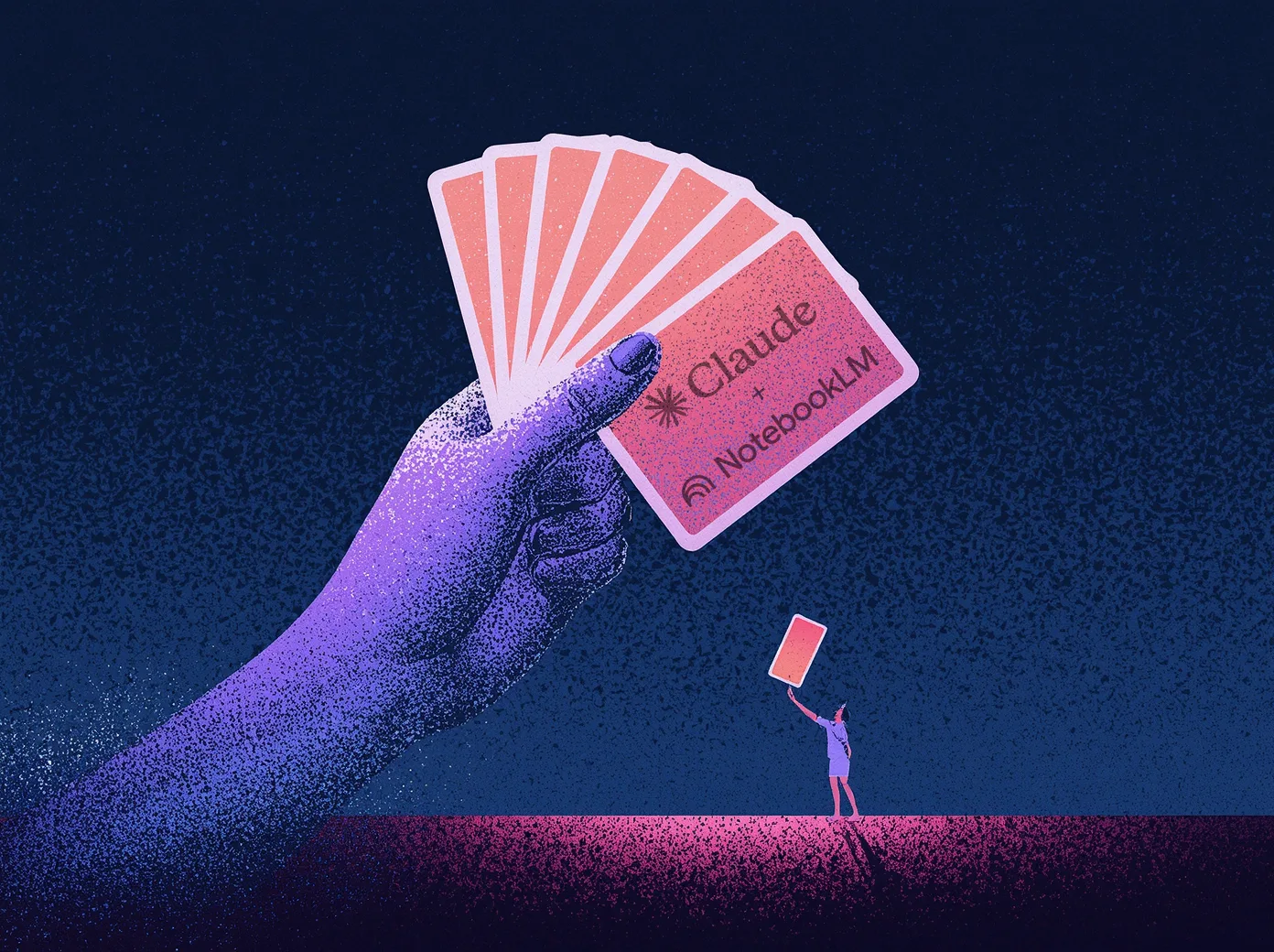
AI turned a four-hour job into a four-minute one. Paste your notes, ask for flashcards, and a hundred cards appear before your coffee is cold. Then exam week arrives and you remember almost none of them.
Here is the catch nobody mentions: AI is brilliant at making flashcards fast, and terrible at making flashcards that stick. The speed is real. The retention is not, unless you direct the tool properly. This guide is the part that turns a generated deck into one you will still recall on the ward, in the viva, or in the written paper.
1. Why most AI flashcards quietly fail
When you drop a chapter into ChatGPT or Claude and ask for cards, it does what language models do best: it summarises. It packages your notes into tidy question and answer pairs that look great on screen. But looking great and being memorable are different things. The same failures show up again and again:
The usual failures
- One card asking three things at once
- Answers you recognise but cannot actually retrieve
- Phrasing copied word for word from your notes
- Cards with no topic, so you forget what they belong to
- Two hundred cards dumped in with no curation
What a good card does
- Tests exactly one fact or idea
- Forces you to recall, not just nod along
- Is reworded, so you learn the concept not the sentence
- Carries its topic in brackets for instant context
- Survives a ruthless edit before it ever gets imported
The fix is not to abandon AI. It is to stop letting it improvise.
2. The one rule that matters most
In 1999, Dr Piotr Wozniak, who built the algorithm that Anki is based on, wrote Twenty Rules of Formulating Knowledge. It is still the closest thing to a flashcard bible. Most of it collapses into one principle that AI breaks constantly, the Minimum Information Principle: each card should test one tiny thing.
Describe the median nerve: its roots, the thumb muscle it supplies, and the test used for carpal tunnel.
The median nerve arises from C6 to T1, supplies abductor pollicis brevis among other thenar muscles, and Tinel's sign over the carpal tunnel reproduces symptoms.
Splitting feels like more work, and it is. But three sharp cards beat one bloated card every single time, because your brain can either retrieve a fact or it cannot. There is nowhere to hide in a card that asks for one thing.
3. The prompt that fixes 90 percent of it
A vague prompt gives vague cards. A directive prompt that spells out exactly how to behave fixes nearly every failure mode at once. Paste this into ChatGPT, Claude, or Gemini, then add your curated notes underneath.
You are an expert flashcard author helping a physiotherapy student revise for exams. I will paste either my own notes or a chapter exported as JSON. Turn it into flashcards, following these rules strictly:

1. ONE idea per card. If a fact has two parts, make two cards. Never compound.
2. Force active recall. No yes/no, no multiple choice, nothing answerable by recognition.
3. Every question is specific and unambiguous, with exactly one correct answer.
4. Keep answers short, ideally under 15 words. No lists on the back unless the list itself is the fact being tested.
5. Use cloze deletion for facts, values, and definitions. Use question and answer for mechanisms and reasoning.
6. Start every question with the topic in brackets, e.g. [Median nerve].
7. Reword everything in your own words. Never copy phrasing from the source.
8. Keep only high-yield content: definitions, mechanisms, special tests, nerve supply, red flags, drug actions, normal values, classic presentations. Drop trivia, history, and filler.
9. For high-stakes facts like drug doses or normal values, only include them if the source states them clearly. Flag anything uncertain instead of guessing.
10. Output as CSV with two columns, Front and Back. Wrap any field containing a comma in double quotes.

After the CSV, list anything in the source that looked incomplete, contradictory, or worth double-checking.

Here is my material:
[paste your notes or chapter JSON here]
The CSV output drops straight into Anki, Quizlet, or any other flashcard app. One prompt, and you have ruled out compound questions, recognition cards, copied phrasing, and missing context before a single card exists.
4. The context window problem, and the workflow that beats it
This explains most bad AI decks. Every model has a context window: the amount of text it can truly hold in mind at once. Even the ones advertising huge windows do not attend to all of it. Drop a 600 page textbook in, and the model skims, forgets the middle, and invents structure that was never there. The cards come back shallow because the AI never had a real grip on the book.
Never do this. No AI has a proper grip over a whole book, not Claude, not Gemini, not ChatGPT. Uploading an entire textbook and asking for flashcards is a shot in the dark. You get low yield, generic cards every time, no matter how good your prompt is.
The fix is to split the work in two: use ChatGPT to cut the book into small structured pieces, then hand those, one chapter at a time, to Claude to turn into cards.
- Split the book by chapter in ChatGPT. Have it break the book into its real chapters and work through them one at a time, never all at once.
- Export each chapter as JSON. Chapter title, topics, and high yield facts. JSON is the format the next model reads most reliably.
- Send one chapter to Claude. Paste its JSON with the master prompt above. Small and focused, so Claude attends to all of it and filters trivia instead of drowning in it.
- Edit and import into your spaced repetition app.
It is also cheaper: you never resend the whole book, so you burn a fraction of the tokens, and every surviving card is high yield.
Step one. Paste this into ChatGPT with your book attached:
I have uploaded a textbook. I want to turn it into flashcards later, one chapter at a time, so first I need it cut into clean structured pieces.

Do this:
1. List the real chapters or major sections of the book.
2. For the chapter I name, output a single JSON object with these fields:
   - "chapter": the chapter title
   - "topics": an array of the main topics it covers
   - "high_yield": an array of the key facts, definitions, mechanisms, normal values, and special tests worth memorising, each written as a short plain statement
3. Skip history, filler, and side notes. Keep only what is testable and high yield.
4. Do not write flashcards yet. Only produce the structured JSON for the one chapter I pick.

Start by listing the chapters, then wait for me to choose one.
Use GPT to cut and structure, and Claude to craft the cards, never one tool for the whole book.
5. Edit every card, because that is where you learn
This is the step everyone skips, and the one that matters most. Generative AI hallucinates. It invents drug doses, swaps nerve roots, and writes cards that are technically correct but lazy. Before you import anything, go through each card and:
- Delete cards on things you already know cold.
- Split any card that secretly tests two things.
- Reword questions that still sound like the textbook.
- Add your own example, mnemonic, or clinical hook to the back.
- Verify any number against your notes before trusting it.
There is a memory principle called the generation effect: material you produce or actively change yourself is remembered far better than material you passively receive. By editing the AI's draft, you are not just cleaning up a deck. You are already studying. The card you fix at midnight is the card you recall on exam morning.
6. A 30-minute routine you can repeat per chapter
- Minutes 0 to 10. Read the chapter once for understanding. Highlight the 10 to 15 concepts that actually matter.
- Minutes 10 to 15. Paste those highlights into the master prompt. Generate the CSV.
- Minutes 15 to 25. Edit ruthlessly. Split, reword, delete, add a hook. You will land on maybe 20 to 40 strong cards.
- Minutes 25 to 30. Import into your spaced repetition app, tag the deck, and schedule a short daily review.
Repeat that across the semester and by exam week you are reviewing 50 to 80 cards a day, most of them already locked in. A 10-card deck reviewed daily beats a 200-card deck reviewed once a week, always.
7. Mistakes to stop making
- Making too many cards. Thirty great cards per chapter beat two hundred mediocre ones. Burnout is a deck-size problem.
- Never deleting. If a card has failed twenty times, the card is broken, not your brain. Rewrite it smaller or bin it.
- Trusting the AI completely. It will state a wrong dose with total confidence. Verify high-stakes facts against your source.
- Front-loading creation, skipping review. Three hours making cards and zero reviewing them is wasted time. Reverse the ratio.
- Treating cards as your only method. Flashcards are for retention, not understanding. Read and practise first, then card what you have understood.
Frequently asked questions
What is the best AI for making flashcards?
There is no single best tool. The reliable approach is to use two: ChatGPT or Gemini to split a long source into structured chapters, then Claude to turn each chapter into cards with a strict prompt. Splitting the work beats asking one model to handle a whole book.
Can ChatGPT make flashcards that actually stick?
Yes, but only if you direct it. A vague prompt gives compound, recognition-only cards. A directive prompt that enforces one idea per card, active recall, and reworded phrasing fixes most failure modes, and you still edit every card before importing.
Why do AI flashcards fail?
The context window. A model cannot truly hold a 600-page textbook in mind at once, so it skims, forgets the middle, and writes shallow cards. Feeding it one curated chapter at a time produces far higher-yield cards.
How many AI flashcards should I make per chapter?
Aim for 20 to 40 strong cards after a ruthless edit, not 200. A small deck reviewed daily with spaced repetition beats a large deck reviewed once a week.
Skip the setup and just study
Decks built on these exact principles, with spaced repetition handled for you.
References and further reading
- Wozniak, P. (1999). Effective learning: Twenty rules of formulating knowledge. SuperMemo.
- Roediger, H. L., & Karpicke, J. D. (2006). Test-enhanced learning. Psychological Science, 17(3), 249-255.
- Bjork, R. A. Desirable difficulties and the generation effect in learning and memory.
- Ebbinghaus, H. (1885). Memory: A Contribution to Experimental Psychology.